





Mole examination by dermatoscopy

Vyšetrenie znamienok dermatoskopicky

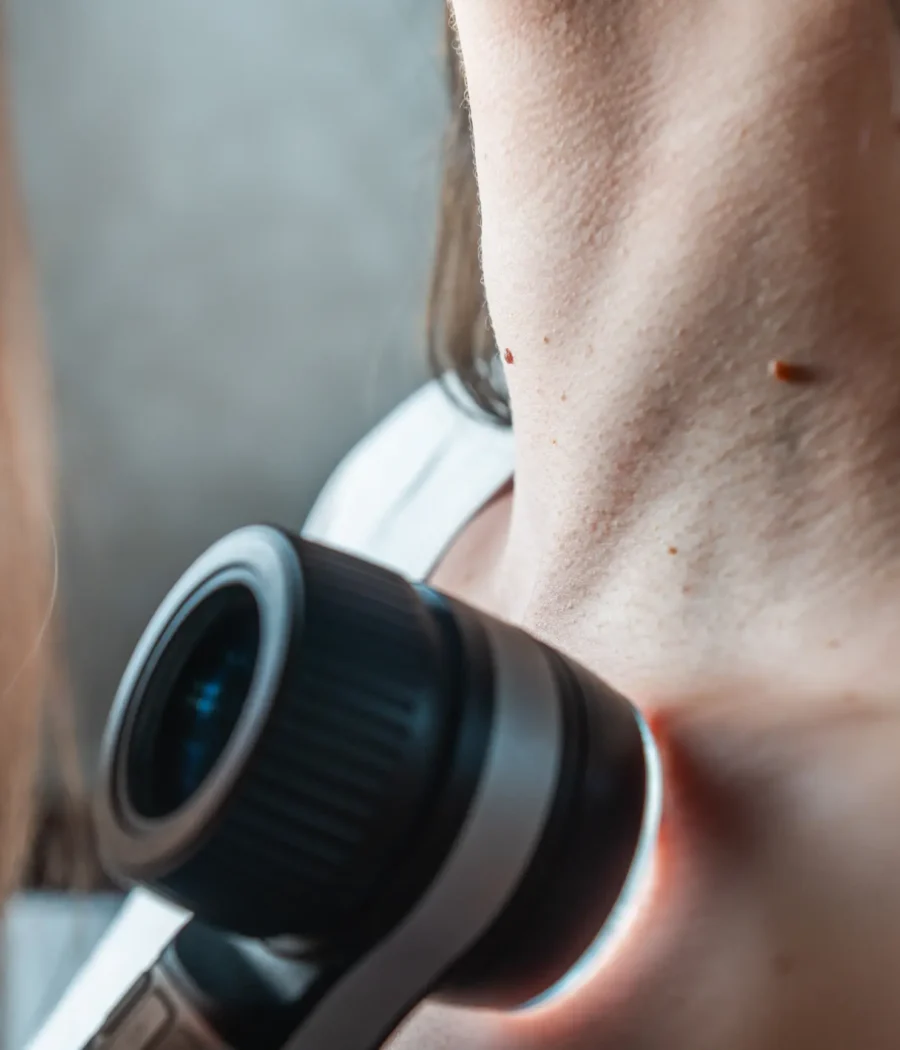
Dermatoscopic mole examination is a non-invasive and highly accurate method for the early diagnosis of skin tumours, especially malignant melanoma. It allows a detailed assessment of pigmented skin lesions and helps the doctor decide which moles need to be removed and which only need regular monitoring.

non-invasive examination using epiluminescence microscopy

high diagnostic accuracy in distinguishing malignant and benign lesions

a safe, painless and quick examination

from 50 €
★★★★★ 4.9/5 (483)

25+ years of experience

21 000+ clients

Vyšetrenie znamienok dermatoskopicky

Treatment information

The term “mole” covers a wide range of skin findings – from pigment spots and pedunculated growths to vascular lesions. From a medical point of view, however, true moles are mainly melanocytic, i.e. pigmented, skin lesions.

Not all moles pose a health risk. A benign mole is usually symmetrical, has sharp and regular edges, uniform colouring in a single shade of brown, and its size is usually less than 6 mm.

Dermatoscopic examination can capture even very subtle changes that are not yet visible to the naked eye, helping to detect any malignant transformation early.

What you can expect from the examination

The examination allows an accurate assessment of moles without any intervention in the skin. The doctor can detect risky or malignant lesions early and recommend the next steps, whether removal or regular monitoring of the mole.

The examination also significantly increases the chance of early detection of malignant melanoma and thus a more favourable prognosis.

Treatment duration
15–60 minutes
Treatment repetition
1× a year
Preparation for treatment
no special preparation
Visible result
immediate professional assessment of the skin

Treatment procedure

1. Preparation

No special preparation is needed. It is recommended not to come freshly tanned. The dermatologist examines the moles using a handheld dermatoscope or a digital dermatoscopy system.

2. Examination

The doctor evaluates dermatoscopic criteria – pigment network, globules, dots, streaks, vascular structures – and also assesses the mole according to the ABCDE rule:

A – asymmetry
B – border
C – colour
D – diameter
E - evolution

3. Digital dermatoscopy (video dermatoscopy)

The mole is recorded with a camera and the software allows it to be monitored over time. During check-ups, the system automatically flags even minimal changes.

4. Recovery

Not required. After the examination, the client returns to normal activities immediately.

Who the treatment is suitable for

  • for everyone who cares about skin cancer prevention
  • for people with a personal or family history of skin tumours
  • for people with a large number of moles or dysplastic moles
  • for anyone who has noticed a change in the shape, colour, size or behaviour of a mole

Who the treatment is not suitable for

  • Dermatoscopy is contraindicated for practically no one.
  • It is not recommended immediately after intense tanning, as increased skin pigmentation may affect the objective assessment of the findings.

Frequently asked questions

No, the examination is completely painless.

No. Only histological examination provides a definitive diagnosis. Dermatoscopy, however, helps decide whether histology is needed.

Usually 1× a year, or more often for risky moles or a positive history.

Treatment price list

Treatments 1 treatment
1 mole 1 treatment: 50 €
Each additional mole 1 treatment: 35 €
★★★★★ 4.9/5 (483)

Your journey
It begins with a decision.
Make an appointment.


★★★★★ 4.9/5 (483)

25+ years of experience

21 000+ clients

Expertise that you trust

At MEDISKIN, it has never been about trends. It is about decisions that make sense. And about the feeling you leave with — and for which you return. We work with medical balance and experience. Every step has its reason. Not everything that is possible is also appropriate. And that is precisely where the sense of aesthetics comes in. It’s not about changing your identity; it’s about making you feel good in your own skin. Faith in oneself.

Experienced team of doctors. Expertise based on practice.

Continuity. Not the number of years, but the number of correct decisions.

Accredited results. Confidence confirmed by real experiences.

Discrete space. Comfort and peace.